Sunday, November 3, 2013

Insight on the Concept of Mpemba Effect

Mpemba Effect

The Mpemba effect is the assertion that warmer water can freeze faster than cold water and is so named after a Tanzanian student, Erasto Mpemba from Africa. His first encounter with this phenomenon started in 1963 in Form 3 of Magamba Secondary School while freezing ice cream mix which was hot initially and his observation that it froze before the cold mix. On upgrading from his O level examinations, he went on to be a student of Mkwawa Secondary School in Iringa, Tanzania where the headmaster invited Dr. Denis G. Osborne from the University College, to conduct lecture on physics after which, Mpemba put forward a question asking why, when two similar containers with equal volume of water, one at a temperature of 35 degrees Cent; and the other at 100 degrees Cent; when placed in the freezer, the one with 100 degrees Cent; freeze first.

For this, Erasto Mpemba was ridiculed by his classmates as well as his teachers, but after initial confusion, Dr. Osborne experimented back at his workplace and confirmed Mpemba’s finding and the results were published in 1969. To understand the factors involved in how the water freezes will help to explain the Mpemba Effect. Here the temperature is the factor in water freezing and the temperature of water in the container is the average energy of its molecules where the heat of the water is defined as total amount of energy of its molecules. The heat depends on the content of the water and how many molecules are present in the container.
The change takes place when a container of water is placed in the refrigerator, in the freezer compartment, the water first cools and then freezes. When the temperature of the water drops down, the heat of the water – energy of the water molecules reduces and at this point, when the temperature reaches 0 degrees cent; the water changes from the liquid to a solid state. A point to be noted here is that the temperature of the water keeps dropping till it reaches freezing point and stays at 0 degrees cent; until the water becomes solid. When the water has turned into ice, its temperature can tend to be lower if the air temperature is lower. Most of the cooling is done through conduction, where the container is in direct contact with cold material namely the freezer shelf and gets cold thereby cooling the contents by conduction. Since metal is a good conductor, a metal container would quicken the cooling of water by conduction while wood is a poor conductor of heat.

Air which is in contact with the container as well as the water transfers heat to the cooler air through conduction which helps in lowering the temperature of the water. Convection is the transfer of energy through movement of currents of liquid which can be seen while heating a vessel of water on a stove, the effects which can also be seen on a cold windy day. Cold water being denser than warm water, will sink to the bottom of the vessel causing convection currents during freezing process and when the temperature reaches below 4 degrees cent; it tends to get less dense and float to the top till it finally freezes. Air convection also helps to move the cold air around so that the water gets cooled through air convention.

Evaporation is also another factor which helps the warm water to freeze quicker than cold water since the evaporation from hot or warm water is more, than in cold water and the during the evaporation process it carries some of the water resulting in less water to freeze in a particular container though it causes the temperature to drop due to heat loss in the warm container. Dissolved gases are another possible factor which has the effect of lowering the freezing point and water always has these impurities in the form of oxygen and carbon dioxide. As the water gets heated, the gases escape because they are less soluble in water at higher temperature and when hot water cools with less dissolved gas, it has a higher freezing point and freeze fast than the water which is not heated.


With the knowledge on the factors that are involved in the freezing process, it has been concluded that the Mpemba Effect takes place based on conduction, convection, evaporation, and dissolved gases. Another theory is that, frost can slow down the cooling process and if hot water is kept in the freezer in a container which is a good conductor of cold or heat, the heat of the container can melt away the frost that is collected on its surface including the ice at the bottom which when refreezes creates a good connection between the container and the surface. This provides a good conduction of cold than a container with cold water having frost on its surface as well as at the bottom, resulting in heat being drawn out from the warm container more quickly than with cold water in it. As the layer of frost at the surface can slow down the process of conduction of heat from the water, a layer on the surface on the upper side of the water can insulate water from colder air currents.

Wednesday, October 30, 2013

History mystery: Anyang Chinese capital in the Bronze Age -1


Anayang -1
Masterpieces of sculptured bronze attest to the brilliant civilization of the Shang dynasty. Another Shang legacy – a collection of bones etched with questions for the ancestral gods – reveals clues to the birth of the Chinese language. Towards the end of the 19th century, Chinese peasants tilling their fields near Anyang, in the northern province of Henan, unearthed hundreds of ancient bones inscribed with strange writing. They sold their discoveries to apothecary shops, believing that they were dragons’ bones charged with magical healing powers.

Scholars soon realized that the bones were of great historical interest, but serious excavations in the area did not begin until 1928. Under the direction of Dr. Li Ji of the Academia Sinica (a Chinese research institute, now based in Taipei), archaeologists unearthed thousands more of the inscribed bones, which had been carefully stored in chronological order. The inscriptions were questions for the ancestors of the mighty Shang kings, who ruled from 1750 to 1027 BC.

Anyang-2
They were the only written records of a vanished civilization. In the 14th century BC, the warrior-king Pan Geng had initiated a new era in the Shang dynasty when he moved his capital north from Yan – a place not yet identified – to the site of Anyang. He called his new city Yin, and historians refer to this second Shang era, which lasted until 1027 BC, as Yin, and to its rulers as Shangyin. Little was known about the period until the excavations at Anyang. By 1937, more than 100,000 objects had been unearthed, and the inscribed ‘bones’ – including ox shoulder-blades and the lower shells of turtles – were recognized as tools of divination.

Yin spread across several sites near present-day Anyang. At the nearby village of Xiaotun, the foundations of 53 large buildings were excavated, including those of a single-storey royal palace built on several large terraces. The buildings had evidently been part of an important ceremonial complex – following an earlier tradition hundreds of human sacrifices had been placed beneath them.

Anyang-3
The victims may have been prisoners, captured in the wars waged against neighbouring communities by Shang kings such as the great Wuding of the 13th century BC. The palace itself was the heart of Yin, the last capital of the Shang dynasty. The 20 buildings which made up the palace had been built along both sides of a central street.

The larger buildings were about 40 m (131 ft) long and 10 m (33 ft) wide, and – on the evidence of the marble sculptures, woodcarvings, and bronzes discovered in the royal tombs – richly decorated. Space, light, and luxury were the exclusive privileges of the royal family and the court. The ordinary people of Yin lived in holes in the ground, in pits and dugouts of many shapes and sizes. The pits, which were probably roofed with thatch, were between 3 m and 4 m (10 ft and 13 ft) deep. Steps led down to a rammed earth floor, in which smaller pits were dug for storage purposes.

Anyang-4
The inscriptions on the bones found at the site offer the most important evidence about life under the Shang dynasty. These inscriptions preserve the earliest known Chinese writing and confirm the historical basis of some legends; they also record everyday life in Yin. Many inscriptions seek predictions for the day’s hunting. This pastime seems to have been a royal sport – to provide animals for sacrifice rather than for food. The Shangyin were essentially farmers. Questions inscribed on the bones reveal their staple crops:

 ‘Is this a year to grow rice?’
‘Is this a year to grow millet?’

Back came the answers inscribed by diviners:
‘This year is a good year for sorghum.’
‘Go out and harvest the wheat.’

Some inscriptions show that the Shangyin knew how to breed silkworms and make silk fabrics. Traces of silk wrappings have been found in one of the Yin tombs, around a bronze vessel. Of the hundreds of bronze vessels discovered in the tombs, more than half were used for wine. Alcohol played an important role in the social life of the city, and in its religious rituals. Wine made of fermented cereals was used in sacrificial rites, and libations were poured onto the ground after burials.

Anyang-5

The royal burial chambers lay at Xibeigang, north of Yin. Each tomb contains several bodies, and is surrounded by subsidiary tombs. On the death of a Shang king, his intimate followers and servants were buried with him – as many as 500 people were sacrificed at each royal death. In most of the tombs, the skeletons of dogs were found next to the royal sarcophagus, guarding their master against the evils of the spirit world. In one area, an entire company of soldiers and four charioteers with horses and vehicles had been buried.

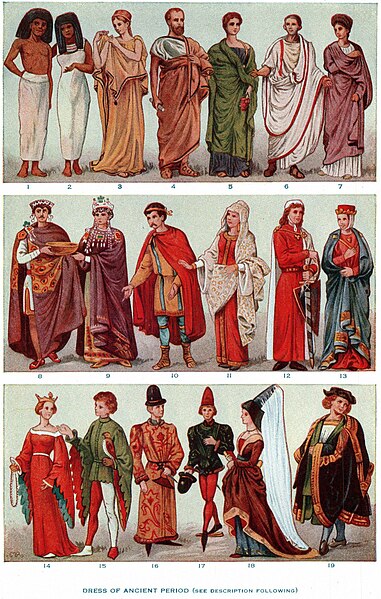
The Origin of Clothes

According to the bible, Adam and Eve walked around naked, and they did not become ashamed of their nakedness until they ate from the Tree of Knowledge. We are not born wearing clothes, and our ancestors didn't have clothing brands or preferences, and yet today the clothes we wear are a firm part of our identity. Even the least fashion conscious people among us have clothing that they wear for work and more casual outfits for weekends and days off. Who invented clothes, and when did they become such an important part of our lives?
Neanderthal Fashion

According to Rebecca Wragg Sykes, an archaeologist at the University of Bordeaux, there is evidence to suggest that Neanderthals wore clothes. The oldest preserved fragments of garments are just 8,000 years old, but "ghost impressions" of clothing have been found in the graves of Homo Sapiens from far earlier than that, and scraps of dyed fabric have been found at a 30,000 year old cave site in Georgia. So, not only did our ancestors from tens of thousands of years ago cover themselves to stay warm, they cared, to some extent, what those cover-ups looked like.

From Cover Up to Comfort

Early garments were made of fur, rough fabrics, beads and teeth from animals. It wasn't until much more recently that our ancestors started to think about comfort. The first records of silk garments can be traced back to ancient China, about 10,000 years ago. Interestingly enough, Chinese legends claim that silk was invented by the Empress Si Ling Chi just 5,000 years ago.  The Empress stumbled upon the properties of silk entirely by accident, when a cocoon from a silk worm fell into her cup of tea. After seeing the cocoon unravel, she had the fine strands spun into threads, and that accidental process formed the basis of silk making for millennia to come,

Silk making stayed a Chinese secret for thousands of years. It was not until 200BC, when many Chinese people migrated to Korea, that the practice of making silk spread, and it took more than 1,000 years after that for silk to become commonplace in other parts of the world.

Becoming Fashion Conscious

While the idea of the rich wearing one type of garment and the poor wearing another was common throughout history, fashion as we know it today took much longer to develop. In the late 13th century, dyeing and wool-working technology advanced significantly, allowing for a wider variety of garments to be made more easily. It was those advances that gave rise to fashion in the modern sense of the word. Fashion conscious people would request curved seams (instead of the traditional straight steams) or have hose with different coloured wool for each leg.

Over the next few hundred years, fashions became more distinct and outlandish. The most well-off people would import new styles and textiles from foreign countries, and decorative lace and needlework became popular as ways to distinguish garments. A few decades after the industrial revolution occurred, mass production of clothing became a reality, and this meant affordable garments for all.

Modern clothing is comfortable, durable and highly customizable. We are lucky to live in a world of technical fabrics, natural silk and rugged denim. Our ancestors suffered for their love of fashion, wearing animal skins and uncomfortable woollen garments. Spare a thought for the Neanderthals and their bone necklaces next time you wrap up in a light and comfortable sarong.

We are all aware that clothing is a necessity, it’s very touching to think that everything we are taught today like sewing was once ‘discovered’ by the humankind. The discovery of new fabrics and new textiles allowed for more creativity and influenced the way people were dressed back than just like it is now. This post was written by Gozde who is currently working with Patra on a guide to the history of clothing and different clothing eras.   

The Institute of Marriage of Ancient Romans

Ancient Roman Marriage -1
The Romans considered marriage as the fundamental institute and looked upon it as something sacred. There were different forms of marriage and the most convenient and traditional type was reserved for Patricians known as Confarreatio which was presided by the Flamen Dialis and involved the eating of wheat bread loaf which was part of the ceremony. The ceremony involved the transferring of the father’s authority over the bride, to the new husband. The second form of marriage was the coemptio which involved a contract. The third form of marriage was called Usus which was equal to a man taking the woman after spending an uninterrupted year of living together. Eventually, a fourth form of marriage developed which left the authority over the bride with her father – patria potestas and this form of marriage enabled to free the woman once her father died and though the authority at first passed to the husband this eventually weakened and woman became free to do as she wished with their inheritance. The three forms of marriage had different degrees of rights as well as different difficulty in divorce.

Ancient Roman Marriage -3
Unlike Usus, which is appropriately named was common particularly with the plebeians. After marriage the Roman woman would leave her father’s home and family to enter the home of her husband and once married, she was almost equal to her husband though not of the same legal standing with regards to the state. The Roman woman had the liberty to visit the city and go shopping or visit friends unlike the Greeks. Once the woman was married, she would take charge of her husband’s household, its slaves; look after the children’s education, especially the girls and take control of the family treasury. It is said that fathers would look after the education of their sons especially in the early ages till the Republic.

The ancient marriages ceremony also differed according to class and rank and the privilege of the ful shebang was for the noble Patricians. With regard to clothing, the bride would wear a particular type of hair-do; probably a wig which was similar to the style of the Vestal Virgins and the hair was split into six parts each of which was plaited. The splitting of the parts had to be done with a spear as a symbol of the warrior culture where the bride was marrying.

Ancient Roman Marriage -2
She would wear a long dress with a veil along with garlands of flowers while the dress was tied at the waist with a special knot and the groom would wear a formal dress, a plain Toga. Their wedding ceremonies began in the morning and a lamb was offered as a sacrifice in consultation with the augurs. They had the exchange of rings like the present times which in the beginning was of iron but later they used gold. They entered into a contract in the presence of a number of witnesses along with the Pontifex Maximus or a high rank priest. The priest in his turn would ensure that the couple joining in matrimony had to make certain their intention of marriage and that there was no reason where they might be prohibited from entering into marriage. The ceremony would proceed thus where the couple would sit holding their right hand together with the sacrificial lamb’s skin across their knees and would then eat the loaf of bread made from primitive unselected wheat which had been prepared especially for the bride for this special occasion. The wedding ceremony was then preceded by dinner at the bride’s father’s place with lavish food and drink followed with singing of songs called thalassius or thalaossi with music played on the flute and other musical instruments. The bride and the bridegroom, after dinner would be accompanied to their new home by their guest in a lively procession accompanied by a lit torch from the father’s home to light the hearth of their new home.

Ancient Roman Marriage -4
Then as a sign of leaving all childish things behind, those gathered would throw walnuts since nuts were very common in a child’s game. The bride would then oil the door’s hinges with melted Tallow in order to keep the sorcery away and the groom would lift the bride over the threshold which is also done in present days. Carrying the bride over the threshold was probably something to do with the threshold being sacred or it could done in remembrance of what the early Romans did while abducting the Sabine virgins, or probably done to avoid the stumbling of the bride while crossing the threshold since the stumbling was considered as a bad sign. Once the couple had entered their new home, the husband would hand over the key of the door, together with water and fire as a symbol of chastity and purity and then proceed to take her to the nuptial bed.

Roman proccession
Their family and friends would then have to wait until a matron who herself had been married said the necessary prayers and then the gathering leaving amidst joyful singing of songs in jest leaving the married couple wherein the bridegroom performs his task of untying a special knot of the bride’s belt to enjoy a happy married night. All are once again invited back the following morning to the new house for lunch with the bride formally being the new member of that family followed by her first sacrifice to her husband’s family spirits known as lares. 

wedding

That day the groom would also get engaged with his friend on a drinking match known as repotia during which a rule maker would be elected who was called the arbiter binendi. The Plebeian ceremony on the other hand resorted to a simpler style of marriage which was a contract between the groom and the father of the bride. Earlier it involved weighing and documenting the dowry which was to be handed over to the groom but later this became more of a formality than the actual marriage. Besides this all other marriage ceremonies remained the same including the dining and lunching.

Monday, October 28, 2013

Science Mystery: Interesting Facts About The Golden Ratio

Golden Ratio -1
The Golden Ratio is often referred as God’s fingerprint and is also the twenty first letter of the Greek alphabet. It appears in nature and is also the universal law of the divine number showing the interrelations in life and is the only number which adds as well as multiplies simultaneously. Phi or the Golden ratio is also called by other names like the Fibonacci numbers, divine, mean, golden mean, golden section or golden spiral and is the main source code applied to all intelligent divine creation as well as number assigned to man. It can also be applied to anything in the world like shells, water, sunflowers, roses, snowflakes, art, planets, animals’ symbol of man, DNA and much more. The Golden Ratio, the most ancient sacred principle known as the Divine Proportion is expressed by the Greek letter phi and is often found in designs of icon down the ages and around the world from Chartres Cathedral to Stonehenge to the Great Pyramid.

Golden Ratio -2
Famous personalities like Michelangelo, Da Vinci and Fibonacci used the Golden Ration in order to create their genius work and the credits on the beauty of the piece of art of Mona Lisa goes to the ideal proportion of the Golden Ratio. Earlier it was considered that the Golden Ratio could only be applied to arts and architecture but through the innovative medical professionals who have come to the realization that the immense benefit in improving the health can come through Golden Ratio with regards to health and the well being of humans. Based on Friedman’s intuition and supported by a variety of scientific studies, the British Medical Journal in December 2009 published a study informing that the Golden Ratio could be an important predictor of heart attacks. According to the study’s lead author from Innsbruck Medical University in Austria, Professor Hanno Ulmer states that a healthy hearts exhibits the harmonious golden ratio. Professor Ulmer, after analyzing blood pressure readings from people over 160,000 in number, found that those with a ratio of 1.6180, which is the mathematical value of the Golden ratio, between the maximum and the minimum blood pressure, had a lower chance of having a fatal heart attack.

Golden Ratio -3
What is the Golden Ratio – When 2 quantities demonstrate divine proportionate the Golden Ratio and if the ratio of the sum of the 2 quantities or number to the large quantity is equal to the ratio of the larger quantity to the smaller one, the Golden Ratio’s mathematical value arrived is 1.6180339887 and for most of us, this can be understood better with diagrams than with words or numbers. The number of man in the human body is 5 which is based on Phi and in the occult world is symbolized as an upright pentagram having two feet on the ground, with two arms extended to the side and the head in ascendant position to the heavens – AS ABOVE. This upright pentagram denotes the spiritual man or Christ who is in control and the pattern of the number 5 corresponding with the 5 elements in nature as SO BELOW. Throughout the physical body, the Golden ratio is expressed in various ways inclusive of bone structure, in the proportion of the section of each finger of our hand and the toe of our feet as well as the proportion of our face which are just the beginning of the numerous ways in which the Golden ratio governs the formation and functioning of our bodies.

Golden Ratio -4
It is therefore essential to understand the principle in order to achieve ideal health and help in the overall improvement of health. According to Dr. Friedman, the Golden Ratio throughout the human body with regards to physiological, anatomical, and molecular levels is an incredible code to be embedded in the structure and function of the body and the more one could apply this principle, life tends to get more effortless and efficient. With our 5 limbs consisting of the legs, arms and the head, each of which contains 5 appendages of fingers and toes which operate with the 5 sensory organs of our head , our two eyes, ears, and the mouth which in turn activates the five sense organs of sight, sound, smell, taste, and touch. As humans we operate efficiently when we use the Golden Ratio to handle how to learn and sense with the use of math of 5 ^ .5 * .5 + .5 = Phi and when we live by the Golden Rule, the philosopher turns the DNA lead into DNA gold. Mathematical construction here means that 5 ^ .5 means that 5 raised to the power of ½ power, is the square root of 5 and is then multiplied by .5 to which is added .5. Our DNA comprises of our looks, intelligence and the ability to excel in any given environment depending on the history of knowledge present in the blood that runs in our veins. In simple phrase the DNA is you and you are your DNA. It is here that the mathematical order takes shape in organizing the order that is within, to operate effectively on the outside with the world according to a particular DNA.

Thursday, October 24, 2013

History mystery:The Intriguing Roman Tale of Eros and Psyche

A king and a queen, the rulers of an unknown city had three daughters of great beauty while the youngest, Psyche, was born with exceptional beauty who was admired by men both far and near. According to some it is believed that she was the second coming of Venus or the daughter of Venus from an unusual union of goddess and mortal The intriguing story of Eros and Psyche is a folktale of ancient Greco Roman world which is written in Roman style though Psyche retains her Greek name. Psyche according to Greek Mythology, was the deification of the human soul and is portrayed in ancient mosaics as the goddess with wings of a butterfly since psyche in ancient Greek means butterfly and according to Greek word psyche is related to life or animated force, spirit, soul and breath, Eros and Aphrodite are called by their Latin names – Cupid and Venus where Cupid is portrayed as a young adult instead of a child. The story relates the struggle for love and trust between Eros and Psyche and Aphrodite became jealous of the mortal princess’s beauty when her altars were left barren while men worshiped a mere human woman instead and made offerings and prayed to her. Hence she commanded her son Eros who was the god of love, to make Psyche fall in love with the ugliest person on earth.


Eros and Psyche 2
On the contrary, it turned out that Eros himself fell in love with her and was completely mesmerized by her beauty. The two sisters of Psyche who were married were envious of her though Psyche was yet to find the love of her heart. Her father suspecting that they had incurred the wrath of the gods consulted the oracle of Apollo who informed the king that he should not expect a human son in law, but a dragon like creature whose face she would not see. This news was not what her parents had expected and they were very sadden over it, but all the same, they proceeded with the arrangement of the marriage of their daughter with the beast. After the wedding, Psyche could be with her husband only at night and his tenderness and immense love for her, made Psyche extremely happy and her expectations beyond her dreams. She often longed to meet her family and one fine day Eros relented and invited her two sisters to his palace. Psyche confided with her sisters and informed them of the sadness she felt on not seeing his face. The sisters on seeing the sight of the palace and all the richness it contained were filled with envy and maliciously informed her that she was being fooled by her husband and he was a fearsome monster from whose clutches she should escape.

Psyche’s bliss got ruined by the visit of her jealous sisters who caused her to betray the trust of her husband who seemed to be not only an ugly beast but one day would kill her and that she should kill him in order to save herself. It took Psyche some time to get convinced on what her sisters told her since she had not faced any kind of dread or fear at the hands of her husband. Psyche finally decided to take their advice and she decided to betray her husband by plotting to kill him one night. Taking the knife in her hands and an oil lamp she set out with her plan to murder her husband and when the light of the lamp fell on the face of her husband, she sought the face of the handsome god Eros with two white wings.

On seeing him she was not at all afraid but taken by surprise and in confusion, she spilled the oil from the lamp on his face and Eros seeing the knife and the lamp in her hand flies away on his two white wings, informing Psyche that he had been betrayed and wounded by her and that their relationship which is ruined will never be the same again/ Eros leaves his wife Psyche who in turn is very upset over the whole episode and is filled with grief over what she had done. She goes in search of her lost love wandering all over the earth. She is so filled with despair that at one point of time she runs to a river and throws herself in the water but Pan the god of shepherds saves her and pulls her out of the water.


While searching for her lost lover, she is advised to beg Aphrodite who has imprisoned Eros in the Palace for an opportunity to meet him and Aphrodite suggests her three impossible tasks to be performed to prove her love for Eros. With all intent and purpose to meet her lover she fearless undertakes to accomplish the two tasks given to her. The third task to be performed was to go to Hades or underworld and bring along the box with the elixir of beauty back to Aphrodite with the instructions not to open the box but instead of the elixir it was Morpheus, the god of sleep and dreams which was hidden in the box. Psyche being curious opened the box and fell into a deep slumber. When Eros her lover got to know of what had happened he approached Zeus and begged him to save his love Psyche. Zeus in his turn was amazed by their love for one another, relented and permitted them to meet once again. He even went further by making Psyche immortal in order that the two lovers could be together forever.


They are happily joined together once again and together they have a daughter by the name Voluptas or Hedone which means physical pleasure or bliss. This is the story of two unusual beings that come together in an unusual situation and their love story is filled with mysteries which are gradually unraveled bringing about a happy ending of a love that is true though each of them undergo a trail of different form to prove the depth of the love they have for each other.

One Giant Struggle - The First Space Walk; 1965

By the sixties the main space agencies had realised there is nothing like stretching your legs after a long drive. The race was on to conduct the first walk in space. The Soviets were so determined to complete a successful spacewalk that they boldly pushed Alexei Leonov out of the airlock in March 1965. Going where no man had gone before proved easy enough – but getting back into where man had just been proved somewhat harder.
The live TV feed of Leonov’s bold, slightly stilted steps, was abruptly cut, officially due to transmission difficulties. The reality on the final frontier was that scientists had not accounted for the effects of space on the suit Leonov was wearing, or the technicalities of keeping him alive for any longer than forty five minutes. The result was that Leonov was running out of air and his space suit had become rigid, making it difficult (very nearly impossible) to manoeuvre sufficiently to open and then re-enter the airlock.

In what can only be described as sheer bravery (Leonov himself used the word "desperation") he persisted in his efforts, eventually beating the odds, squishing his bloated and rigid suit back head first into the airlock. By some miracle Leonov vented just enough oxygen from his suit to continue breathing while not actually raising his body temperature boiling point – all of which he achieved alone.

The mission was successful although even the re-entry was plagued with problems; the capsule's automatic guidance system failed. This required the crew to manually land the ship, avoid hitting China (harder than you might think from a height) and inadvertently starting a war, whilst also avoiding any major population centres. On re-entry the module began to spin wildly and went into free-fall which resulted in them landing so far off course that nobody was quite sure if they had landed – at least in one identifiable piece. The authorities assured their families that they had landed safely and were 'resting' which, depending on your interpretation of the word, was kind of true.

Stranded in Siberia, surrounded by aggressive wolves and bears in temperatures as low as 30C was something of a walk in the park for Leonov and his colleagues. However, issues with the capsule's doors (again) made the night uncomfortable. Unable to shut the door, the cosmonauts had to endure the temperatures, a fact which was not helped by the sweat that had pooled inside their spacesuits. Proving that even space explorers can be down to earth, practical types, they stripped, rung out their wet clothing and pulled the space suits apart to access the layers of softer, warmer material. More or less respectably dressed once more they were rescued the following day when a passing cargo plane picked up their signal. The nine kilometre ski to the nearest rescue helicopter probably made the whole experience seem like a holiday. No doubt the sort of experience that you laugh about later; much later.

While the first spacewalk didn't go entirely to plan and the landing didn't go much better, with a wish.co.uk experience everything should run much more smoothly.
Space Travel Infographic
Freelance writer Chris Hoole is fascinated by the bits of space exploration history that nearly went wrong.  Here he explores the near-disaster of the first spacewalk.